

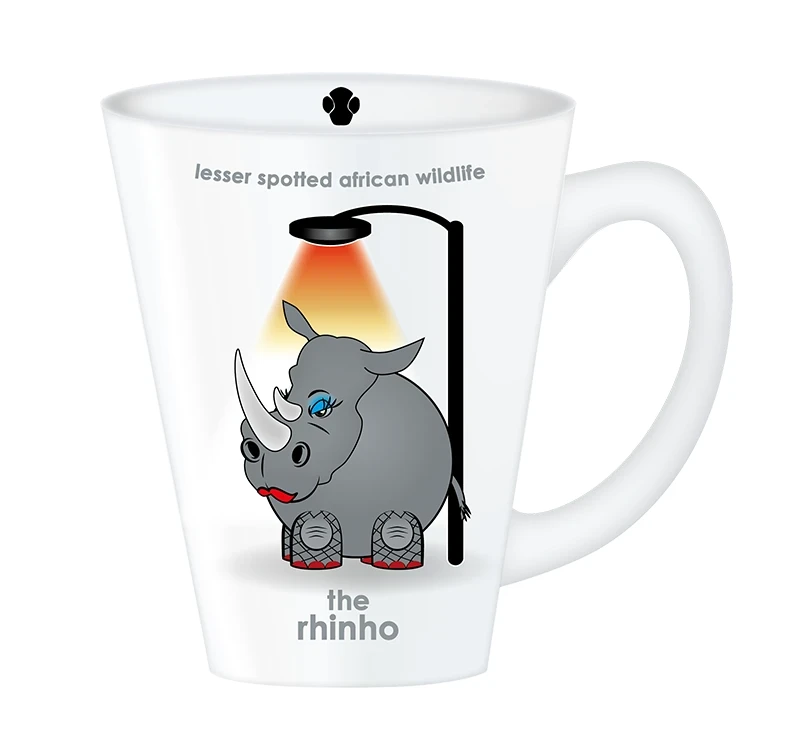
Rhinho mug
R165.00
As a young lass, the Rhinho fell on hard times and sadly chose the wrong path, adopting the world’s oldest profession. Read more of her sad, desperate tale in the description below ..
Availability: In stock
As a young lass, the Rhinho fell on hard times and sadly chose the wrong path, adopting the world’s oldest profession.
As streetlights (and customers) are few and far between in the bush, she hangs around on the outskirts of cities. She hopes, beyond hope, for her own Pretty Woman happy ending.
So far, there’s been no sign of her Prince Charming. But each night, she faithfully dons her fishnets and Chanel lips and hangs around optimistically with the other ladies of the night.
About our LESSER SPOTTED AFRICAN WILDLIFE latte mugs:
This is what you get with each mug, you lucky person, you!:
- ○ 12oz (350ml) unique Lesser Spotted African Wildlife cone-shaped latte mug
- ○ Premium grade ceramics with scratch-resistant finish
- ○ Dishwasher- and handwash-friendly
- ○ Microwave-safe
- ○ Individually hand-made in Cape Town
- ○ The ideal gift for a friend, family member or loved one – or for you
*Please don’t scrub hard with bleach and a scourer, even if you’re a die-hard germaphobe (true story) – treat your Rhinho mug gently and it’ll give you years of pleasure and amusement.
ALL ABOUT rhinos:
There are two distinct species of rhino in South Africa: white (Ceratotherium simum), who are more sociable and prefer open grasslands and savannas, where they can graze on short grass and black (Diceros bicornis), who are more solitary and territorial and prefer dense bush and thickets and woodlands. Both species are classified as the Big Five!
Strangely, they’re both grey but the white ones have squarish lips. Our friend, the Rhinho, is a black one and, true to type, is rather solitary and territorial when it comes to her turf (mainly her lamppost).
Unlike crocodiles or hippos, they rarely kill humans.
If you’re lucky, you’ll spot them in the Kruger and other wildlife reserves
KEY TRAITS:
Size and appearance: They’re the second-largest land mammals after ellies. Black ones weigh 1.5 to 2.7 tons and are 1.6 to 1.8m tall at shoulder height. The white ones weigh 0.8 to 1.4 tons and are 1.4 to 1.6m tall (shoulder height).
Best known for: Their prehistoric features and the prominent horns on their foreheads, which, sadly have been mostly removed. This was done as a response to an epidemic of poaching, which has decreased their numbers significantly. Their horns are presumed to be powerful aphrodisiacs in the East and poachers fetch a handsome amount for them, stripping the poor rhinos of their horns and leaving their butchered carcasses to rot.
There are far fewer black rhinos left in South Africa these days because of it – only about 2000 of them 🙁
Lifespan: They typically live for 35 to 50 years in the wild, with their greatest threat being poachers.
Social Structure: A group of them is known as a crash – no surprises there.
Their Diet: They’re herbivorous so highly unlikely to want to eat you.
Breeding: Females gestate for about 16 months, so they’re only out-gestated by ellies, and produce a single calf every 2.5 to 5 years.
Spoor Description: They have three toes: the white rhinos have larger tracks with a W shape at the back and the black ones’ are more rounded with a much shallower indentation (it’s not so easy to tell in my diagram but I assure you it’s there. Sort of).

Collect the full set of 12 Lesser Spotted African Wildlife mugs and give your family and friends an inspirational topic for filling awkward silences.
| Weight | 300 g |
|---|---|
| Dimensions | 120 × 100 × 120 mm |
| Size & Colour | 12oz (350ml) White |
Brand
Lesser Spotted African Wildlife

You must be logged in to post a review.


Reviews
There are no reviews yet.